Palm Oil
Mondelēz International is committed to sourcing palm oil sustainably, to seek no deforestation and helping to prevent and address human rights violations in the palm oil supply. We take this responsibility seriously.
Supplier Engagement - Our Palm Oil Action Plan
For years, we have actively worked with our global suppliers to ensure that the palm oil we use in our products is sustainably sourced and fully traceable. In fact, we were the first multinational consumer goods company to require suppliers to trace all the oil they sell, not just the oil they sell to us.
In 2014, we published our Palm Oil Action Plan, a long-term roadmap to achieve a sustainable palm oil supply, which we launched after achieving our milestone of 100% Roundtable on Sustainable Palm Oil (RSPO) palm coverage in 2013. Since then we have worked toward further evolving and enhancing our approach, as reflected in published updates of our Palm Oil Action Plan. By the end of 2025 we aim to source palm oil that is RSPO physically certified. In conjunction, we are also adopting a No Deforestation, No Peat, No Exploitation (NDPE) Implementation Reporting Framework (IRF). Our 2025 update of the Palm Oil Action Plan reiterates our position and principles for palm oil sustainability, focusing on supplier expectations, government and sector engagement in key origins and global industry advocacy toward sector transformation.
By the end of 2024, 99 percent of the palm oil sourced by our company was traceable to the mill, and 100 percent was purchased from suppliers that are aligned to our Palm Oil Action Plan.
From 2020, we require traceable, forest-monitored palm oil from mills across our supply chain. The requirements include traceability to plantation and satellite monitoring covering all palm oil concessions supplying mills attributed to the company, against the deforestation criteria set out in its Palm Oil Action Plan. In addition, suppliers are asked to provide 3rd party assurance of their mill list data. From 2025 we require our suppliers to submit verified NDPE IRF profiles annually. Our methodology is aligned with the Consumer Goods Forum Forest Positive Coalition Methodology.
The Mondelēz International Palm Oil Action Plan details actions to achieve our goals to make sustainable palm oil the mainstream option, based on the principles that production should follow the No Deforestation, No Peat, No Exploitation (NDPE) Implementation Reporting Framework (IRF) which encompasses to not lead to deforestation or loss of peat land; respect human rights, including land rights, the rights of Human Rights Defenders; and not use forced or child labor.
Our Palm Oil Action Plan requires suppliers to:
- Take full responsibility for eliminating deforestation in their own operation and upstream supply chain by mapping and monitoring all plantations and immediately suspend companies involved in deforestation.
- Take action to uphold human and labor rights in their own operations and upstream supply chains by:
- Having a policy in place to respect human rights, including labor rights, in own operations and upstream supply chain, and the rights of Human Rights Defenders, in line with the UN Guiding Principles on Business & Human Rights (UNGPs) and the CGF Priority Industry Principles on Forced Labor
- Implementing effective human rights due diligence in line with the UN Guiding Principles on Business and Human Rights (UNGPs)
- Ensuring that the principles of Free Prior and Informed Consent and non-retaliation against grievance raisers are respected and fully implemented
Sector Engagement - Our Landscape Initiatives
While Mondelēz International accounts for only about 0.5 percent of palm oil consumption globally, we have played – and continue to play – a leadership role in global industry advocacy toward sector transformation.
To date, we have partnered and engaged with several of the leading global organizations focused on improving the palm oil supply chain.
- We are active member of the Consumer Goods Forum’s (CGF) Forest Positive coalition
- We co-chair the Consumer Goods Forum Human Rights Coalition and play an active role in its initiatives to help promote human rights within the palm oil supply chain, including the P3 Project which aims to address forced labor risk in the Malaysian palm supply, efforts to improve sector practices in respecting the rights of Human Rights Defenders, and collective action to help resolve grievances related to land conflicts
- We have supported the United Nations Development Program (UNDP), the Government of Indonesia, and others to develop a National Action Plan for palm oil
- We are supporting the development of the Coalition for Sustainable Livelihoods, a group of civil society, private sector, and government organizations working collectively to strengthen smallholder livelihoods, improve agriculture and conserve forests in North Sumatra and Aceh, Indonesia
Mondelēz International is proud to be a long-standing member of multistakeholder platform Coalition Sustainable Livelihood (CSL) where we are actively collaborating and contributing to its mission in advancing shared goals for more sustainable production, improved livelihood, and conservation of critical natural resource in Aceh and North Sumatra, Indonesia. Since joining the CSL as a Founder and Steering Committee member in 2018, we have been involved in shaping the platform’s strategic direction, focusing on key initiatives, and sharing valuable learnings.
As part of this broader sector approach Mondelez International has been assessing the forest footprints of major Palm growing countries and regions guided by Rainforest Action Network’s (RAN) methodology for forest footprint assessments. These forest footprints in turn inform Mondelez’s landscape-level initiatives where we partner with other organizations aiming to reach broader impact.
Example: Forest Footprint Aceh, Indonesia and related landscape initiatives (mill data 2023)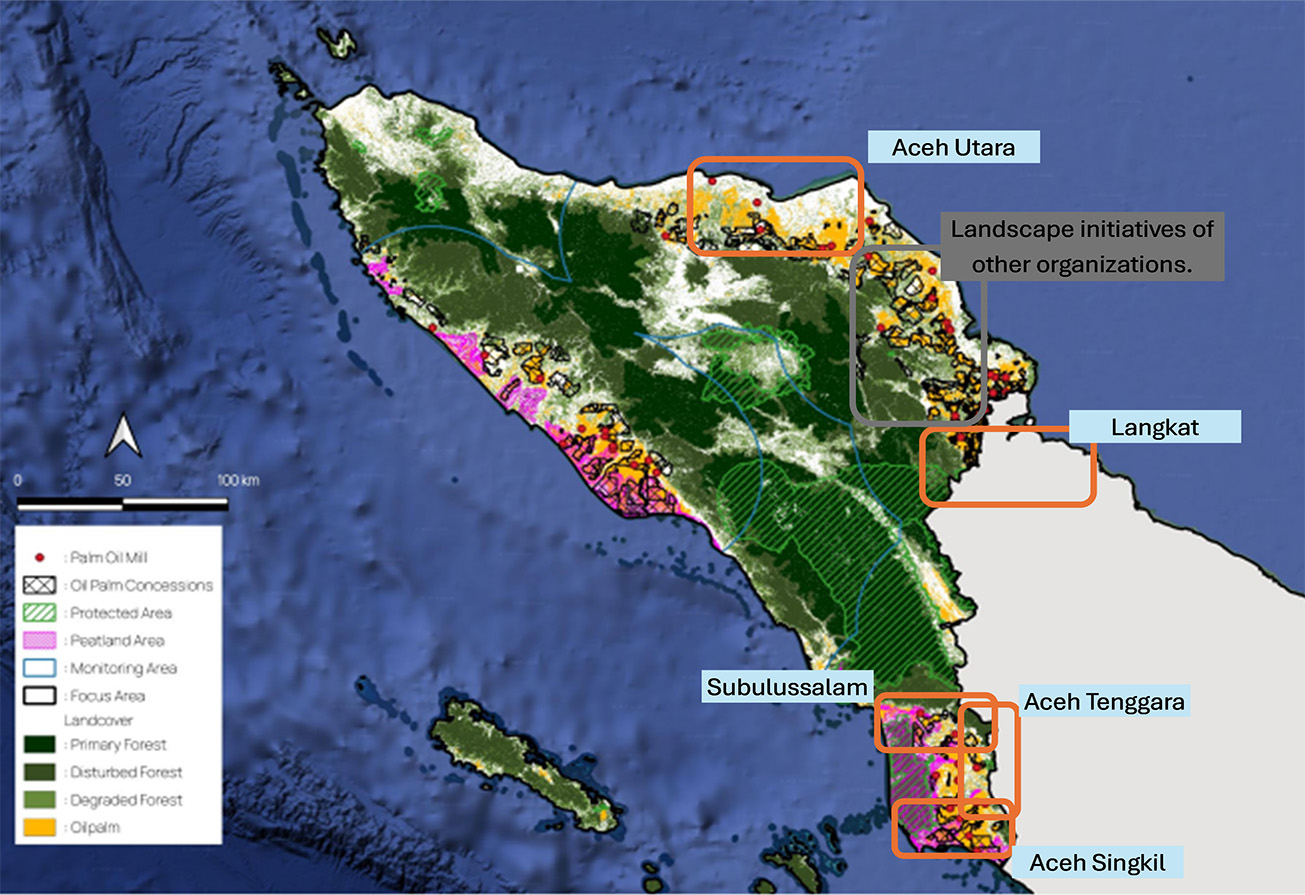
Our efforts to help protect the Leuser Ecosystem in North Sumatra and investing in the landscape initiative Langkat North Sumatra in partnership with IDH (Sustainable Trade Initiative) and PT Smart Tbk (a subsidiary of Golden Agri Resources, or GAR) continued in 2024 (Langkat District - Sustainable Supply Chain Management).
Building on the experience from the ongoing implementation in Langkat District, we have expanded the landscape initiative to other districts in Aceh Province, such as Langkat, Aceh Utara, Aceh Singkil and Subulussalam. The project aims to support the strengthening of sustainable palm oil governance in the respective areas, which are part of the palm oil sourcing landscape that also host the biodiversity rich Leuser Ecosystem.
Since 2024, we have further actively contributed to a multi-stakeholder initiative “Respecting Indigenous Peoples and Local Communities Rights Affected by Agricultural Production in Indonesia” aimed at supporting collective action to help address some of the root causes of land rights issues in Indonesia. In Aceh, the project focuses on combining engagement and dialogues with local stakeholders as well as helping to train mediators on land rights and conflict mediation. This is implemented through the existing Aceh Landscape Initiative.
Launched on 13 August 2025, Mondelez is part of the Aceh Sustainable Palm Oil Working Group a voluntary, non-commercial, and pre-competitive working group that aims to help support the Aceh Province’s Sustainable Palm Oil Roadmap (2023–2045) through individual and joint efforts aiming to create enabling conditions for inclusive, deforestation-free palm oil.
Our work and collaboration with other organizations is based on our view that the complex challenge of producing sustainable palm oil can only be solved through collaboration with all actors in the palm oil supply chain, from growers to suppliers and buyers, as well as local and national government and non-governmental organizations. We remain committed to achieving complete sustainability and transparency across our supply chain and the industry at large, and will continue to provide regular updates on our progress.